
Imagine a world where waste is nothing but a distant memory. I recently stumbled upon a small company in Oregon that transforms discarded fishing nets into skateboard decks. This ingenious repurposing got me thinking–what if more businesses adopted such creative, sustainable business practices?
The concept we’re talking about here is the circular economy. This isn’t just an eco-friendly innovation or a fleeting trend. It’s a groundbreaking model that addresses our most pressing environmental challenges while offering substantial circular economy benefits, like increased efficiency and economic resilience. By shifting from our traditional, resource-intensive linear economy to a circular one, we focus on reducing waste, conserving natural resources, and unlocking new avenues for growth.
Table of Contents
Key Takeaways
- The circular economy helps eliminate waste by repurposing materials.
- It promotes sustainable business practices and eco-friendly innovation.
- Resource efficiency is key to reducing environmental impact.
- A circular model offers economic resilience and growth opportunities.
- Transitioning to this model is crucial in a resource-constrained world.
Understanding the Circular Economy
The circular economy offers a transformative vision for how we manage resources, emphasizing resource efficiency and sustainable growth. By moving away from the traditional “take-make-waste” model, the circular economy aims to keep products, materials, and resources in use for as long as possible.
What is the circular economy?
At its core, the circular economy is about creating a closed-loop system where waste is minimized, and everything is reused, remanufactured, or recycled. This approach not only promotes waste reduction but also ensures that we extract the maximum value from resources while they are in use.
Learn the Basics
Linear vs. circular models
The traditional linear model operates on a straightforward path: extract raw materials, produce goods, consume, and dispose. In contrast, the circular model seeks to eliminate waste at every stage. By designing products that can be easily disassembled and repurposed, we enhance resource efficiency and pave the way for sustainable growth.
Principles of circular economy
The circular economy is underpinned by several key principles:
- Designing out waste and pollution: Products are crafted to minimize waste throughout their lifecycle.
- Keeping products and materials in use: Extending the life of goods through reuse, repair, and remanufacturing.
- Regenerating natural systems: Ensuring that the production processes contribute positively to the environment, thereby fostering waste reduction.
Principles of circular economy
By embracing these principles, businesses and communities can achieve greater resource efficiency and drive sustainable growth, laying the foundation for a more resilient and environmentally friendly economy.
The Environmental Benefits of Circular Practices
Circular practices offer extensive environmental benefits that contribute to a more sustainable future. By redesigning products and processes, these practices address some of the most pressing environmental issues.
Reducing waste and pollution
One of the key advantages is the reduction of waste and pollution. Through better waste management, we can minimize the amount of waste that ends up in landfills, thereby decreasing land and water pollution.
Conserving natural resources
Efficient use of resources is another critical aspect. Circular practices ensure that we conserve natural resources by reusing, repairing, and refurbishing existing materials. This approach significantly lessens our environmental impact by reducing the need to extract and process raw materials.
Mitigating climate change
Finally, these practices play a pivotal role in mitigating climate change. By lowering greenhouse gas emissions through reduced dependency on new resources, circular methods support the global effort towards sustainability and combating climate change.
| Aspect | Linear Model | Circular Model |
|---|---|---|
| Resource Use | Extracts and depletes resources | Conserves and reuses resources |
| Waste Management | Generates significant waste | Minimizes waste through reuse |
| Environmental Impact | High pollution levels | Reduced pollution levels |
| Greenhouse Gas Emissions | High emissions | Lower emissions |
Economic Advantages of the Circular Economy
Adopting the principles of the circular economy offers numerous economic advantages, from cost efficiencies to fostering new business opportunities. By focusing on sustainable practices and reducing waste, businesses can significantly benefit in the long run.
Cost efficiency and savings
Circular business models drive cost efficiency by optimizing resource use and minimizing waste. This efficient use of resources ensures that companies can reduce their operational costs while contributing to environmental sustainability. Savings are typically seen in resource procurement, waste management, and energy consumption—ultimately boosting the bottom line.
New business opportunities
The shift towards circular business models opens up a range of new business opportunities. Industries such as recycling, remanufacturing, and sustainable product design offer lucrative prospects. These opportunities encourage innovation, allowing businesses to develop new products and services that are both economically viable and environmentally friendly.
Job creation and economic growth
One of the most compelling advantages of the circular economy is its potential for job creation. As new markets and industries emerge, the demand for skilled labor increases, generating employment opportunities and fostering economic growth. Sectors such as green technology, sustainable manufacturing, and waste management are becoming fertile grounds for job creation—supporting a robust and resilient economy.
| Advantage | Impact |
|---|---|
| Cost Efficiency | Reduced operational costs and higher savings |
| New Business Opportunities | Innovation in recycling, remanufacturing, and sustainable design |
| Job Creation | Increased employment in emerging green sectors |
| Economic Growth | Expansion of markets and industries |
Challenges in Implementing Circular Models
Adopting circular models comes with its own set of difficulties. From regulatory and policy challenges to the absence of standardized data, and the necessity for business adaptation, firms must navigate a complex landscape. Addressing these issues is crucial for the successful integration of circular economy standards into business practices.
Regulatory and policy barriers
Various regulatory and policy barriers hinder the adoption of circular models. Businesses often struggle with inconsistent legal frameworks across different regions, complicating efforts to implement uniform circular economy standards. These discrepancies require strategic business adaptation to cater to region-specific regulations.
Lack of standardized data
Another critical hurdle is the lack of standardized data. Without a unified approach to data collection and reporting, assessing the environmental impact and benefits of circular practices becomes difficult. This gap hampers transparency and accountability, making it challenging for businesses to comply with circular economy standards. Such inconsistencies pose significant policy challenges for both corporations and regulators.
Business model restructuring
The shift from linear to circular models necessitates comprehensive business model restructuring. Traditional business models, built around a “take-make-dispose” approach, must evolve to focus on sustainability and resource efficiency. This transformation requires substantial investment and planning, presenting a formidable barrier to the widespread adoption of circular practices. Effective business adaptation is essential to overcome these structural challenges and fully realize the potential of a circular economy.
Role of Technology and Innovation
The rapid advancements in technology are transforming how we approach sustainability in our daily lives and business operations. From data sharing to recycling and product design, innovation is at the heart of creating a more sustainable future.
Digital Platforms for Data Sharing
Digital platforms facilitate real-time data sharing, making it easier for companies to collaborate and maintain transparency across global supply chains. By leveraging technology in sustainability, businesses can track resource usage, optimize logistics, and minimize waste, ultimately contributing to more efficient and responsible operations.
Innovative Recycling Methods
Innovative recycling technologies are significantly enhancing material recovery processes. Methods such as chemical recycling and advanced sorting techniques enable the effective separation and reintegration of materials into the production cycle. These advancements not only reduce environmental impact but also promote the circular use of resources.
Smart Product Design
Smart product design integrates sustainability from the conception phase, focusing on creating products that are easier to repair, upgrade, and recycle. By incorporating sustainable product design principles, manufacturers can extend the lifecycle of their products and reduce overall waste. This proactive approach ensures that sustainability is built into the foundation of product development, aligning with the broader goals of a circular economy.
| Technology Aspect | Benefits |
|---|---|
| Digital Platforms | Enhanced collaboration and transparency |
| Innovative Recycling | Improved material recovery and reduced waste |
| Smart Product Design | Extended product lifecycle and reduced overall waste |
Key Sectors Embracing Circular Economy
The adoption of circular economy principles varies significantly across different industries. By embracing these innovative models, key sectors are setting benchmarks for others to follow. Those leading the way include manufacturing, construction, and fashion and textiles.
Manufacturing
The manufacturing sector is increasingly aligning with the circular economy through sustainable manufacturing practices. Companies are now prioritizing the use of recycled materials and energy-efficient processes, reducing waste and promoting resource efficiency. This shift not only promotes environmental sustainability but also drives economic benefits by cutting costs and creating new market opportunities.
Construction
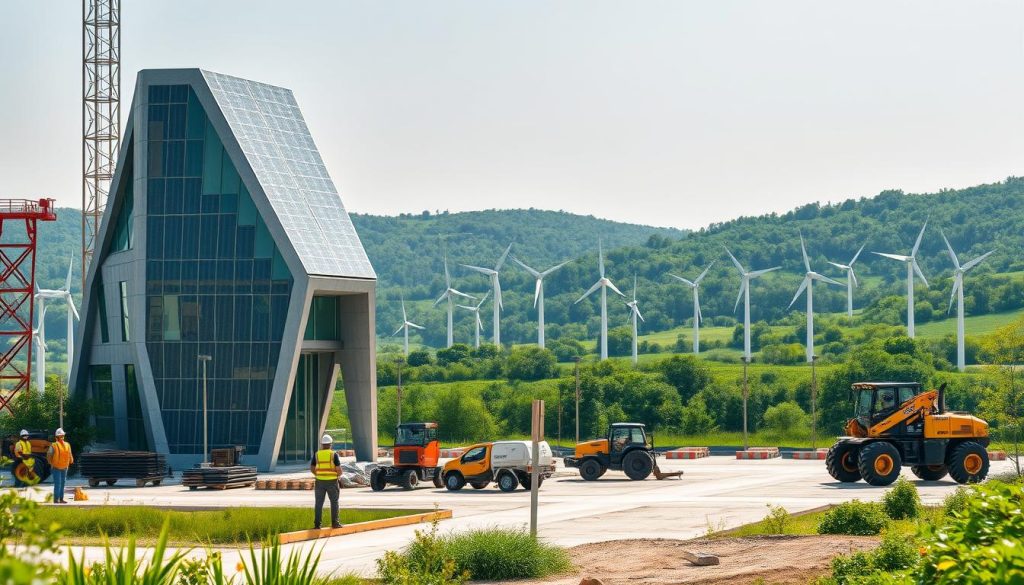
Construction is another industry making significant strides toward a greener future. Green construction techniques emphasize the use of sustainable materials, energy-efficient designs, and waste-reducing methods. By adopting these practices, the sector is not only mitigating the environmental impact but also meeting the growing demand for sustainable living spaces. Projects incorporating these elements are increasingly recognized for their long-term economic and environmental value.
Fashion and Textiles
The fashion and textiles sector is embracing the circular economy through eco-friendly fashion initiatives. Brands are exploring sustainable textiles, innovative recycling methods, and ethical production processes. This transformation is crucial in addressing fast fashion’s environmental footprint. By producing durable, recyclable, and ethically made clothing, the industry can significantly reduce waste and promote a more sustainable consumption model.
Global Adoption and Regulatory Frameworks
Achieving global sustainability standards requires a unified approach and robust regulatory frameworks. Two major frameworks driving these efforts are the Paris Agreement and the EU Circular Economy Action Plan. These initiatives illustrate global efforts toward environmental responsibility and regulatory cohesiveness.
Paris Agreement targets
The Paris Agreement is a landmark accord focusing on climate change mitigation, adaptation, and finance. It sets ambitious targets for reducing carbon emissions to limit global warming below 2 degrees Celsius. By adhering to the guidelines and frameworks established under the Paris Agreement, countries worldwide aim to promote sustainable practices and meet global sustainability standards.
EU Circular Economy Action Plan
The EU Circular Economy Action Plan is an integral component of the European Green Deal. It seeks to establish a sustainable economy with high resource efficiency, promoting products and services that are designed to last longer and are easier to recycle. EU regulations under this plan encourage innovation and aim to create a more resilient economy while reducing environmental impact.
Collaborative Initiatives and Partnerships
In today’s interconnected world, sustainability partnerships and circular economy initiatives are proving to be crucial in driving global collaboration. These initiatives bring together diverse stakeholders to foster a more sustainable future.
Global Battery Alliance
The Global Battery Alliance is one of the foremost examples of how partnership can accelerate sustainable practices. This alliance aims to establish a circular and responsible value chain for batteries, ensuring that they are reused, recycled, and responsibly sourced. By promoting such initiatives, we can significantly reduce the environmental impact of battery production and disposal.
Catena-X
Catena-X is pioneering a collaborative approach to streamline data exchange across the automotive industry. This initiative is an exemplary model of how digital platforms can drive circular economy initiatives by standardizing data sharing and promoting transparency. The result is a more efficient and accountable supply chain, ultimately contributing to a sustainable and innovative automotive sector.
Gaia-X
Gaia-X focuses on building a reliable and secure data infrastructure for Europe, enabling seamless global collaboration among businesses and governments. By fostering interoperability and trust, Gaia-X supports the creation of robust sustainability partnerships across various sectors, facilitating the continuous development of circular economy practices on an international scale.
Practical Steps for Businesses
Transitioning to a circular economy can seem daunting, but practical steps can help streamline the process and ensure effective integration. Below are crucial steps for businesses looking to embark on this transformative journey.
Developing a circular strategy
Creating a comprehensive plan is the first step in developing robust circular strategies. Businesses should start by analyzing their current practices and identifying areas where resources can be optimized, reused, or recycled. It’s essential to set clear, achievable goals and allocate the necessary resources to implement these strategies effectively.
Engaging stakeholders
Successful implementation requires active stakeholder engagement. It’s crucial to involve all relevant parties—employees, suppliers, customers, and community members—in the conversation. Hosting workshops, surveys, and regular communication can foster a sense of collaboration and alignment with the company’s circular goals.
Measuring and reporting progress
Establishing clear metrics is indispensable for effective sustainability reporting. Develop a robust system for tracking progress, utilizing both qualitative and quantitative data to measure achievements against set benchmarks. Regularly publishing these reports not only provides transparency but also helps in fine-tuning strategies for ongoing improvement.
| Step | Action | Outcome |
|---|---|---|
| Developing a circular strategy | Analyze current operations; set goals | Optimized resource use |
| Engaging stakeholders | Involve employees, suppliers, customers | Increased buy-in and alignment |
| Measuring and reporting progress | Track and report regularly | Enhanced transparency and improvement |
Conclusion
The journey toward a circular economy is both necessary and rewarding. Throughout this article, we explored the intrinsic benefits of adopting circular practices—from environmental conservation and waste reduction to economic growth and resiliency. By understanding the principles of the circular economy, we can collectively contribute to a more sustainable development.
Technology and innovation play pivotal roles in this transformative process. Implementing digital platforms for data sharing and innovative recycling methods are just a few examples of how eco-innovation can drive meaningful change. Our efforts to embrace the circular economy will significantly reduce our environmental impact and open up new economic opportunities.
To build a resilient and equitable future for all, it is crucial for businesses, policy-makers, and individuals to commit to circular economy principles. By working together and supporting collaborative initiatives, we can pave the way for a brighter, more sustainable future. The circular economy is not just a concept; it is a necessary pathway to a sustainable development and a promising circular economy future.