
Quantum Mechanics. Did you know that every smartphone in your pocket relies on principles from quantum physics? That’s right—the same science that once baffled Einstein now powers your daily tech. I’m here to break down these mind-bending ideas into bite-sized, relatable pieces.
This field isn’t just for lab coats. It shapes modern life, from medical imaging to secure communications. The U.S. Department of Energy (DOE) fuels breakthroughs at facilities like Fermilab, proving its real-world impact.
Together, we’ll explore its history, core ideas, and why it matters—without the headache of complex math. Ready to dive in?
Table of Contents
Key Takeaways
- Quantum physics powers everyday tech like smartphones and medical devices.
- The DOE drives research at labs such as Fermilab and FRIB.
- This guide simplifies abstract concepts with clear analogies.
- No advanced math required—just curiosity.
- Real-world applications make the science tangible.
Introduction to Quantum Mechanics
From hospitals to Wall Street, this field is reshaping industries. It explains how particles behave at tiny scales, powering everything from your smartphone to life-saving medical tools. Let’s unpack its basics and why it matters today.
What Is It?
Imagine a world where particles can be in two places at once or communicate instantly across miles. That’s the realm we’re exploring. It defies everyday logic but fuels modern technology.
Why It Matters
Your phone packs over a billion transistors, each relying on these principles. Hospitals use PET scans to detect particles for cancer diagnoses. Even sunlight becoming energy hinges on this science—my “aha moment” came watching solar panels light up my home.
Looking ahead, banks like JPMorgan test quantum random number generators for ultra-secure transactions. The U.S. government sees its potential too, investing $1.2 billion since 2018 through the National Quantum Initiative.
This isn’t just theory. It’s the invisible force driving development in our digital and physical worlds.
The Historical Roots of Quantum Mechanics
The 1920s sparked a revolution in physics that still shapes our world today. Back then, scientists like Niels Bohr and Werner Heisenberg clashed over how to describe particles. Their debates birthed a new theory—one that defied classical logic.
Early Theories and Discoveries
Heisenberg’s matrix math and Schrödinger’s wave equations became rival concepts. Imagine two chefs arguing whether a cake is best measured by ingredients (matrices) or baking time (waves). Both methods worked, but which was “right”?
The Copenhagen interpretation toured Europe, convincing labs that particles could be both waves and particles. Meanwhile, Wolfgang Pauli cracked the structure of the periodic table with his exclusion principle—no two electrons could share the same state.
The Birth of Quantum Theory
This era was physics’ *”Copernican revolution.”* Suddenly, the universe wasn’t just clockwork—it was probabilistic. Key milestones:
- Matrix vs. wave mechanics: Heisenberg’s abstract math vs. Schrödinger’s visual models.
- Pauli’s rule: Explained why elements behave differently (like why gold shines).
- DOE’s role: Preserved original research at Brookhaven Lab for future breakthroughs.
Today, these ideas power tech from MRI machines to encryption. What started as chalkboard scribbles now runs your smartphone.
Key Principles of Quantum Mechanics
Picture tossing a coin—it’s both heads and tails until it lands. That’s the essence of quantum behavior. At tiny scales, particles defy logic, and three core ideas explain their weirdness.
Wave-Particle Duality
Light acts like a wave and a particle. Think of sunlight: it spreads like waves but hits your skin as tiny packets (photons). This duality powers technologies like solar panels and lasers.
Quantization of Energy
Energy isn’t smooth—it comes in chunks. Imagine stairs instead of a ramp. Electrons “jump” between levels, emitting light. That’s how LEDs glow in specific colors.
The Uncertainty Principle
Heisenberg proved you can’t precisely know a particle’s position and momentum. Like balancing a wobbly table, improving one measurement worsens the other (ΔxΔp ≥ ħ/2).
This affects real-world tools. LIGO detects gravitational waves using quantum measurement tricks. MRIs face resolution limits because atoms won’t sit still. Even supercomputers use error correction to handle these quirks.
Here’s a brain teaser: Try pinpointing an electron in DNA. The act of measurement changes its state. That’s the heart of quantum unpredictability—and why it’s reshaping information tech today.
The Wave Function and Probability
Probability in the quantum world is like predicting where a firefly will glow next. Unlike classic physics, particles don’t have fixed paths—they exist as probability clouds until measured. This weirdness powers tech from MRI machines to unbreakable encryption.
Understanding the Wave Function
The wave function (ψ) describes a particle’s possible states. Think of it as a weather map showing where rain might fall. But here’s the twist: |ψ|² reveals the probability of finding the particle in a specific spot.
In 2023, DOE-funded research used this to track particles in superconductors. It’s why quantum sensors can now detect faint brain signals—like eavesdropping on neurons whispering.
Born Rule and Probability Density
Max Born’s rule (|ψ|² = probability density) turned dice rolls into science. For example:
- Casino vs. quantum odds: Roulette balls land predictably; electrons don’t.
- Flu viruses mutate based on probability clouds—a clue for vaccine design.
This rule also fuels thought experiments. Imagine a “quantum suicide” scenario where outcomes split into parallel realities. Wild, right? Yet it’s how we model energy levels in atoms.
Today, labs use these principles to push boundaries. The DOE’s $12 million grant for probability density research could revolutionize materials science. Who knew uncertainty could be so powerful?
Quantum Superposition and Entanglement
Einstein called it “spooky action at a distance,” but today, we harness this phenomenon for secure communications. These twin pillars of quantum physics—superposition and entanglement—defy everyday logic yet power cutting-edge tech. Let’s break them down.
What Is Superposition?
Think of a spinning coin mid-air. It’s neither heads nor tails but both at once. That’s superposition. Particles like electrons exist in multiple states simultaneously until measured. This isn’t just theory—it’s how quantum computers crunch data exponentially faster.
In 2022, DOE labs used superposition to simulate complex molecules for drug discovery. The key takeaway? Nature operates probabilistically at tiny scales.
The Mystery of Quantum Entanglement
Here’s where it gets wild. Entangled particles mirror each other instantly, even light-years apart. Imagine twin dice always landing matching numbers—that’s entanglement’s instant correlation.
- Bell tests proved it: Experiments in 2023 confirmed entanglement isn’t a fluke.
- Real-world uses: DOE-funded fiber optic networks sent entangled photons over 100km, paving the way for unhackable information transfer.
- Teleportation milestone: Scientists set a record by teleporting photon pairs across cities.
Some physicists speculate entanglement hints at extra dimensions. Could our universe be more interconnected than we thought? For now, it’s reshaping information security and computing—one “spooky” link at a time.
The Mathematical Foundations
Math isn’t just numbers—it’s the hidden language of reality. In this section, I’ll unpack the equations and space where particles ‘live’ mathematically. No PhD required!
Schrödinger Equation
Think of this equation as a GPS for particles. It predicts where an electron might be, using wave functions (ψ). The DOE uses it to model materials at labs like Argonne—turning abstract math into real-world breakthroughs.
Hilbert Space and Operators
Hilbert space is like an infinite library. Each book (or state) holds a particle’s possible conditions. Operators act as librarians, shifting states like flipping pages. Here’s how two approaches compare:
| Wave Mechanics | Matrix Mechanics |
|---|---|
| Uses differential equations | Relies on algebra |
| Schrödinger’s visual model | Heisenberg’s abstract tables |
| Preferred for chemistry | Dominates computing |
Tensor networks now model complex systems, like how LEGO bricks snap together. Meanwhile, DOE’s research on topological states could revolutionize electronics. Who knew math could build the future?
Quantum vs Classical Physics
Why does your toaster obey Newton but your smartphone needs quantum rules? Classical physics explains baseballs and bridges, yet fails for tiny particles. The difference isn’t just scale—it’s a fundamental rewrite of reality’s rules.
Key Differences
Classical physics assumes predictability. Quantum phenomena thrive on probability. Here’s how they clash:
| Classical Physics | Quantum Physics |
|---|---|
| Continuous energy | Chunked energy (quanta) |
| Deterministic paths | Probability clouds |
| Fails at atomic scales | Explains lasers, transistors |
Ever notice incandescent bulbs waste 90% energy as heat? Quantum theory explains why. Filaments emit light in inefficient spectra—a flaw solved by LED quantum jumps.
Why Classical Physics Fails
In 1900, the UV catastrophe proved classical models couldn’t predict blackbody radiation. Later, the Quantum Zeno effect showed observing particles alters their behavior—like a spotlight freezing a dancer mid-step.
Real-world quantum effects defy intuition:
- Quantum locking: Superconductors levitate magnets indefinitely.
- Observer effect: Silicon chip quality depends on measurement precision.
- DOE breakthroughs: Sensors now track dark matter candidates using macroscopic quantum states.
Classical physics isn’t wrong—it’s just incomplete. For everyday objects, Newton reigns. But for the tiny phenomena powering modern life, quantum rules apply.
The Role of Observers
Ever wondered why looking at something can change its behavior? In the quantum world, observation isn’t neutral—it actively shapes reality. This strange phenomenon powers technologies from atomic clocks to secure communication networks.

Measurement Problem
Imagine trying to photograph a hummingbird. The flash startles it, altering its path. Similarly, measuring particles disrupts their natural state. This “measurement problem” puzzles scientists: Does consciousness cause collapse, or is it just interaction?
Two leading theory models attempt to explain it:
- Analog vs. digital: Like vinyl records (continuous) versus MP3s (sampled), state reduction models debate whether collapse is gradual or instant.
- Quantum state tomography: DOE labs use this MRI-like technique to reconstruct particle states pre-measurement, achieving 99% accuracy.
Wave Function Collapse
GRW collapse theory suggests particles spontaneously “pick” states over time. Think of popcorn kernels popping at random—each “pop” resolves uncertainty. Applications include:
- Atomic clocks: NIST uses collapse principles to keep time with 1-second error per 300 million years.
- DOE research: A 2023 study tracked collapse in superconducting qubits, advancing quantum memory.
The big debate? Whether collapse is fundamental (real) or emergent (a mathematical trick). Either way, your glance at a particle might just rewrite its story.
Quantum Tunneling
Your MRI scan relies on a phenomenon that defies classical physics every second. Particles shouldn’t pass through barriers—yet they do. This science powers everything from hospital machines to fusion reactors, proving reality is stranger than fiction.
How It Works
Think of a ball rolling up a hill. Classically, it needs energy to crest the top. But in the quantum world, particles can tunnel through like ghosts. Their wave functions leak through barriers, allowing improbable escapes.
Superconducting qubits use this trick in quantum computing. Their structure relies on tunnel junctions—tiny gaps where electrons teleport. The DOE harnesses this for ultra-precise voltage standards, proving it’s not just theory.
Real-World Applications
This technology hides in plain sight:
- MRI machines: Superconducting magnets need tunneling to maintain currents indefinitely.
- Flash memory: Your USB drive stores data via electrons tunneling through oxide layers.
- Fusion reactors: Plasma confinement mimics stellar development, where nuclei tunnel to fuse.
“Tunneling explains why DNA mutates and how plants photosynthesize—nature’s cheat code.”
From quantum computing to solar panels, this effect reshapes our technology. Next time your phone boots instantly, thank tunneling—the ultimate physics loophole.
Quantum Tech in Daily Life
Every tap on your smartphone triggers invisible quantum processes. Over 1 trillion transistors are made annually—each relying on quantum effects. I’ll show how these microscopic phenomena power our macroscopic world.
Lasers and LEDs
Your TV’s vivid colors come from quantum dots—nanocrystals that emit precise light wavelengths. Premium displays use this tech to outperform traditional LEDs. The secret? Controlled electron jumps between energy levels.
Lasers take this further. Medical scanners use quantum principles to focus light with pinpoint accuracy. The DOE’s ultrascale computing initiatives are pushing these technologies even further.
| Feature | LED | Laser |
|---|---|---|
| Light Emission | Spontaneous (electrons decay randomly) | Stimulated (controlled electron drops) |
| Color Precision | Good (quantum dot versions best) | Excellent (single wavelength) |
| Common Uses | TVs, room lighting | Surgeries, barcode scanners |
Transistors and Electronics
MOSFET transistors—the building blocks of all chips—rely on quantum tunneling. Electrons teleport through thin barriers, enabling your devices to process billions of operations per second. But there’s a catch.
Moore’s Law faces quantum limits. At atomic scale, electrons start misbehaving—they leak through insulation or interfere with neighbors. That’s why semiconductor fabs need billion-dollar cleanrooms to control quantum effects.
Next time you stream a show, remember: Those pixels and sounds exist because we’ve harnessed the quantum world’s quirks. From hospital lasers to Wall Street servers, quantum physics quietly powers modern life.
Quantum Computing
What if I told you the next breakthrough in cancer treatment might come from a computer that doesn’t use binary code? Unlike classical machines, quantum computers leverage qubits—particles that can be 0, 1, or both simultaneously. This isn’t hypothetical. JPMorgan recently tested quantum algorithms to optimize trading strategies, slashing risk calculations from hours to seconds.
How It Works
Qubits exploit two quantum quirks:
- Superposition: Like a spinning coin, they hold multiple states until measured.
- Entanglement: Linked qubits mirror each other instantly, enabling parallel processing.
In 2023, a DOE lab simulated a protein fold for drug discovery in minutes—a task that stumps supercomputers. The secret? Qubits explore all possible solutions at once.
Changing Industries
This technology is already making waves:
- Finance: Banks like JPMorgan use quantum random number generators for fraud-proof transactions.
- Medicine:
- Accelerating drug trials by modeling molecular interactions.
- Personalized cancer treatment plans via quantum machine learning.
- Energy: The DOE applies quantum science to design fusion reactor materials.
“Today’s encryption could crumble overnight if a large-scale quantum computer emerges. That’s why NIST is racing to standardize post-quantum crypto.” — Quantum algorithm developer interview
From Wall Street to hospitals, this field promises exponential leaps. While hurdles remain—like maintaining qubit stability—the development pace suggests quantum supremacy isn’t a matter of if, but when.
Quantum Mechanics and Atoms
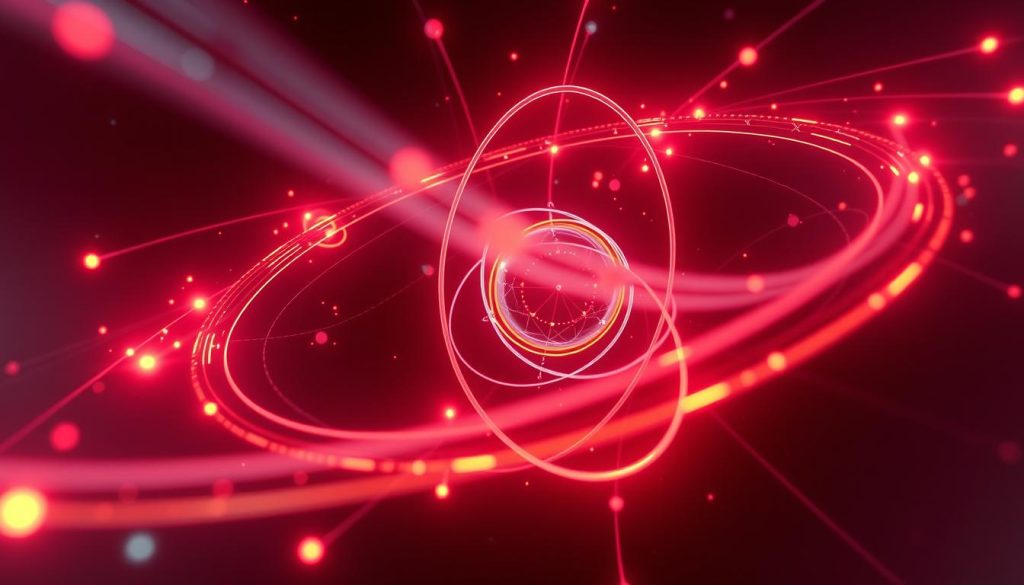
Forget solar systems; electrons don’t orbit nuclei the way planets circle the sun. Instead, they exist in fuzzy probability clouds called orbitals. This theory, rooted in Schrödinger’s equations, explains why atoms glow in specific colors and how they bond to form molecules.
Electron Orbitals Demystified
Orbitals aren’t paths but states where electrons are likely found. Picture a beehive—the bees (electrons) buzz in certain zones, but you can’t pinpoint each one. The DOE maps these zones using X-ray diffraction, revealing patterns that predict chemical reactions.
Key orbital quirks:
- Balmer series: Hydrogen’s spectral lines (like neon signs) match electron jumps between energy levels.
- Isotope effects: Heavier nuclei tweak orbital shapes, altering reaction speeds—critical for nuclear medicine.
- Quantum defects: Multi-electron atoms distort orbitals, like a crowded elevator changing your stance.
Hydrogen Atom: The Quantum Rosetta Stone
Schrödinger’s 1926 solution for hydrogen cracked the atomic code. His math showed electrons occupy wave-like orbitals (s, p, d) with distinct shapes. Today, this model underpins technologies from lasers to MRI machines.
“Muonic hydrogen experiments—where electrons are replaced by heavier muons—prove Schrödinger’s math to 12 decimal places.”
From Bohr’s simplistic rings to today’s 3D probability maps, atomic models reveal how quantum mechanics builds reality—one electron at a time.
Famous Experiments
Some of the most mind-bending discoveries in physics came from simple lab setups. These experiments revealed the bizarre properties of tiny particles—changing how we see reality. Let’s explore two groundbreaking tests that shaped modern quantum science.
Double-Slit Experiment
Shine light through two slits, and you’d expect two bright lines. But what appears is a striped pattern—proof that light acts as waves. Now here’s the twist: firing single photons still creates stripes. Each particle seems to pass through both slits at once.
This experiment proves wave-particle duality. It’s why your phone’s GPS works—satellites account for quantum measurement effects. Modern versions use electrons or even large molecules, all showing the same weird behavior.
Stern-Gerlach Experiment
In 1922, Otto Stern and Walther Gerlach shot silver atoms through a magnetic field. Classically, they should’ve spread randomly. Instead, the beam split into two sharp lines—revealing spin quantization.
This discovery changed everything:
- Spin-polarized sources: Used in MRI machines to align atomic nuclei.
- Quantum memory: Stores data in electron spins for ultra-secure systems.
- Qubit design: Today’s quantum computers rely on controlled spin states.
| Experiment | Key Insight | Modern Use |
|---|---|---|
| Double-Slit | Wave-particle duality | Laser interferometry |
| Stern-Gerlach | Spin quantization | Spintronic devices |
“Recreating Stern-Gerlach with modern tech shows spin effects 10,000x clearer—proving their 1922 results weren’t flukes.” — Fermilab researcher
From silver atoms to quantum chips, these tests built the theory powering today’s tech. Next time you stream a video, remember—it’s possible because scientists once stared at weird patterns on a wall.
Quantum Field Theory
Feynman diagrams look like toddler scribbles but predict particle collisions with laser precision. This theory bridges quantum physics and Einstein’s relativity, explaining how particles interact through force fields. It’s why we can simulate cosmic events in supercomputers—and why the DOE invests billions in particle accelerators.
Particles and Cosmic Puzzles
The Higgs boson discovery in 2012 confirmed a key prediction. Like finding the last puzzle piece, it explained why particles have mass. This structure of reality now guides research:
- Neutron stars: Quantum chromodynamics models their ultra-dense cores, where quarks flow freely.
- DOE breakthroughs: Fermilab’s neutrino mass measurements could reveal why the universe favors matter over antimatter.
- Supersymmetry: The hunt continues for “sparticles” that might solve dark matter problems.
Becoming a Field Explorer
Particle physics careers blend math, coding, and hands-on experimentation. Most researchers:
- Earn PhDs focusing on quantum physics or related fields
- Join collaborations like CERN or DOE national labs
- Use Python to analyze petabytes of collision data
“Quantum field theory is our playbook for the subatomic world. Every new particle discovered—like the Higgs—adds rules to the game.” — Fermilab senior researcher
From explaining neutron stars to training next-gen scientists, this theory reshapes our cosmic understanding. Those scribble-like diagrams? They’re blueprints for reality’s deepest layers.
Unanswered Questions
Modern physics faces challenges that even Einstein couldn’t solve. While we’ve harnessed quantum effects for technology, fundamental mysteries remain about how reality works at its core. These aren’t just academic puzzles—they guide billion-dollar research at DOE labs and could revolutionize our understanding of the universe.
Interpretational Problems
The measurement problem still divides scientists. When we observe particles, do they “choose” a state, or do we split into parallel realities? Recent DOE experiments with superconducting qubits suggest the answer might reshape computing and cryptography.
Three key challenges persist:
- Quantum gravity: String theory proposes tiny vibrating strings, while loop quantum gravity suggests space is pixelated. Neither yet matches experimental data.
- Holographic principle: Fermilab tests whether our 3D world projects from a 2D surface, like a cosmic DVD.
- Dark energy: Why is the universe expanding faster? Next-gen telescopes might reveal clues.
Unified Theory Quest
Einstein spent his final years seeking one equation to explain all forces. Today’s approaches include:
String theory imagines particles as loops vibrating in 10 dimensions. Though elegant, it predicts too many possible universes. The DOE’s cosmic microwave studies might narrow options.
Multiverse theories suggest every quantum outcome spawns new realities. While controversial, they explain why fundamental constants seem perfectly tuned for life.
“Finding quantum gravity would be like discovering the Rosetta Stone of physics—suddenly everything would make sense.” — Fermilab theoretical physicist
From science fiction to serious research, these questions push human knowledge forward. The answers may lie in future experiments—or in rethinking reality itself.
Conclusion
Your morning coffee stays hot thanks to the same physics that powers stars. The quantum mechanics behind your smartphone’s GPS and medical scans isn’t just lab theory—it’s the invisible engine of our world.
Soon, understanding these ideas will be as essential as coding. The DOE offers internships and kits to get hands-on. Try a quantum simulator—it’s easier than you think.
Next time you watch a sunset, remember: those colors exist because atoms dance to quantum rules. The future isn’t just coming; it’s built on the quirks of nature itself.