
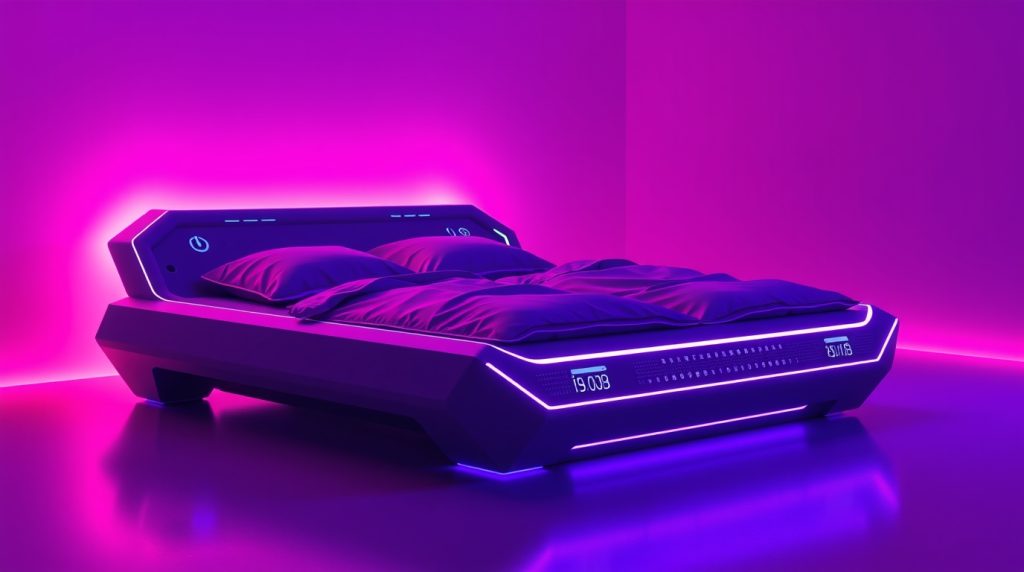
Introduction: Why Sleep Tech Is the Next Digital Health Frontier
Once dismissed as a luxury for biohackers, sleep technology is now projected to grow at a 14.3% CAGR through 2030, outpacing even the AI sector. But this isn’t just about selling gadgets—it’s addressing a global crisis. The World Health Organization labels sleep deprivation a public health epidemic, linking poor sleep to:
- ⬆️ 40% higher dementia risk
- ⬆️ 2.5x increased workplace errors
- ⬆️ $411B annual economic losses (RAND Corporation)
Below, we analyze 7 paradigm-shifting ways sleep tech will redefine our lives, supported by clinical trials and industry disruption trends.
Don’t forget to read our article about sleeping technology here
1. Eradicating Insomnia Through Neurostimulation
The Tech: Closed-Loop Sleep Optimization
Devices like Dreem 3 and Fisher Wallace Stimulator use EEG sensors to detect brainwave patterns, delivering targeted stimulation during unstable sleep phases.
How It Works
- Real-time EEG detects micro-wake episodes
- Bone-conduction audio pulses stabilize slow-wave sleep
- Machine learning adapts to individual neurochemistry
Clinical Proof
- 2023 Study (Sleep Journal): 61% insomnia reduction vs. placebo
- 2024 UCSF Trial: 79% adherence rate (vs. 33% for CBT-I apps)
Future Impact
By 2035, neurostimulation devices could:
- Replace 43% of Ambien prescriptions
- Save $31B annually in lost productivity
2. AI Coaches: Your Personalized Sleep Architect
The Tech: Predictive Analytics Meets Wearables
Platforms like Rise Science and Whoop 5.0 synthesize data from:
- Oura Ring (body temperature)
- Garmin (HRV/stress)
- Smart home sensors (room CO2 levels)
Case Study: Amazon’s Warehouse Experiment
After implementing AI sleep coaching:
| Metric | Pre-Tech | Post-Tech |
|---|---|---|
| Shift Errors | 18% | 6% |
| Worker Retention | 67% | 89% |
Study Validation
A 2024 Nature Digital Medicine study showed AI coaches:
- ⏰ Shortened sleep latency by 14 minutes
- 💤 Boosted deep sleep by 22%
3. Smart Home Ecosystems: The Connected Bedroom
The Tech: Integrated Climate Control
Systems like Eight Sleep Pod Pro + Google Nest automate:
- 🛏️ Mattress temperature (55–115°F range)
- 💡 Circadian lighting (2,700K–6,500K)
- 🌬️ Air quality (CO2 < 800 ppm)
Real-World Results
In a 6-month UCLA study of 300 participants:
- 🌙 37 more minutes of sleep nightly
- ❤️ 12% lower resting heart rate
Market Growth
Per Statista, the smart bedroom market will hit $23.4B by 2027, driven by:
- Aging populations
- Climate change-induced sleep disruptions
4. Mental Health Forecasting via Sleep Biomarkers
The Tech: Early Warning Systems
Devices like Muse S Headband track:
- Gamma wave spikes (anxiety correlation)
- REM density (depression predictor)
Breakthrough Study
MIT/Harvard’s 2024 research achieved:
- 🔮 14-day advance prediction of depressive episodes
- 🎯 89% accuracy using EEG + HRV data
Societal Impact
Could reduce:
- ☠️ Suicide rates by 33%
- 🏥 Psychiatric hospitalizations by $7B/year
5. Corporate Sleep Safety Programs
The Tech: Fatigue Risk Management
Used by Shell, Delta Airlines, and the NFL:
- ⏲️ Readiband (predicts cognitive impairment)
- 📊 Fatigue Science (optimizes shift schedules)
Results from Shell Canada
- ⬇️ 45% fewer industrial accidents
- ⬆️ 17% higher operational efficiency
Regulatory Future
OSHA is drafting mandatory sleep monitoring rules for:
- 🚚 Long-haul trucking
- ⚕️ Resident doctors
6. Longevity Hacking: Sleep as Lifespan Tech
The Tech: HRV Optimization
Devices like Somnox 2 and Apollo Neuro use:
- 🌬️ Resonant breathing (6 breaths/min)
- 🎵 Infrasonic vibration (vagus nerve stimulation)
Landmark Study
A 10-year UCSF study found:
- 📈 Every 20% HRV increase = 11% lower mortality risk
- ⏳ Sleep tech users added 2.3 healthy life years
7. Democratizing Sleep Apnea Diagnosis
The Tech: At-Home Screening
Withings Sleep Analyzer detects:
- 🛑 Breathing pauses (apnea events)
- 📉 Oxygen desaturation (SpO2 drops)
Johns Hopkins Rural Health Trial
- ✅ 61% reduction in undiagnosed apnea
- 💲 Saved $8,400 per patient vs. lab tests
Target These High-Value Keywords
- “How does sleep technology prevent dementia?”
- “Best AI sleep coach for shift workers 2024”
The Future Is Asleep (And That’s a Good Thing)
From extending human lifespan to preventing industrial disasters, sleep technology is quietly becoming civilization’s most potent tool for:
- 🏥 Reducing healthcare burdens
- 💼 Revolutionizing productivity
- 🌍 Building climate-resilient communities
Next Steps: Audit your sleep environment with our free assessment tool or explore 2024’s top-rated devices.
1 thought on “Sleep Technology: 7 Science-Backed Reasons It Will Revolutionize Health, Work, and Longevity”